
Best Prop Firm for Futures: 7 Rules That Decide Value
Compare futures prop firms by drawdown, total cost, payouts, platforms, restrictions, and account structure before buying an evaluation.

The best provider depends less on the advertised account balance than on seven practical rules: total cost, drawdown method, payout access, trading restrictions, platform support, account status, and compatibility with your risk plan. Current provider terms were not supplied for this article, so no price or rule below is presented as verified.
Pas le temps de lire ?
- There is no universally best provider: the right choice depends on your trading frequency, holding period, preferred platform, and ability to manage drawdown.
- Compare the effective loss allowance rather than the advertised account balance, especially when a trailing threshold follows unrealized profits.
- Include activation fees, resets, commissions, data charges, and payout restrictions when calculating total cost.
- Confirm whether the funded stage is simulated or live, which strategies are prohibited, and when profits become withdrawable.
- Recheck every rule on the provider’s official website immediately before purchasing because program terms can change.
Which providers deserve a place on the shortlist?
Verification date: October 8, 2026. Provider-specific prices and conditions are unknown because their current official pages were not supplied.
There is no universal best prop firm for futures. Topstep, Apex Trader Funding, TradeDay, and Earn2Trade are reasonable candidates for a futures prop firm comparison, but the winner depends on how you trade and how each rule is calculated.
| Provider | Current price | Drawdown method | Payout conditions | Platform access |
|---|---|---|---|---|
| Topstep | Unknown | Unknown | Unknown | Unknown |
| Apex Trader Funding | Unknown | Unknown | Unknown | Unknown |
| TradeDay | Unknown | Unknown | Unknown | Unknown |
| Earn2Trade | Unknown | Unknown | Unknown | Unknown |
Before ranking them, record every term from the official rule and pricing pages on the same date. Treat missing or contradictory information as unknown, not favorable. Official sources were not provided, and this article contains no affiliate links.
What does the evaluation really cost?
As of October 8, 2026, no provider-specific fee schedule has been verified for this comparison.
The advertised fee rarely represents the full cost of a futures funded account. Calculate the amount required to reach and maintain the funded stage:
- Evaluation subscription or one-time fee
- Reset or restart charges
- Funded-account activation fee
- Exchange data and platform costs
- Trading commissions
- Refund eligibility and conditions
For example, if E is the evaluation fee, R one reset, A activation, D data, and C commissions, total cost is E + R + A + D + C. Compare that total, not E alone, across an identical time horizon.
How does the drawdown rule change your usable capital?
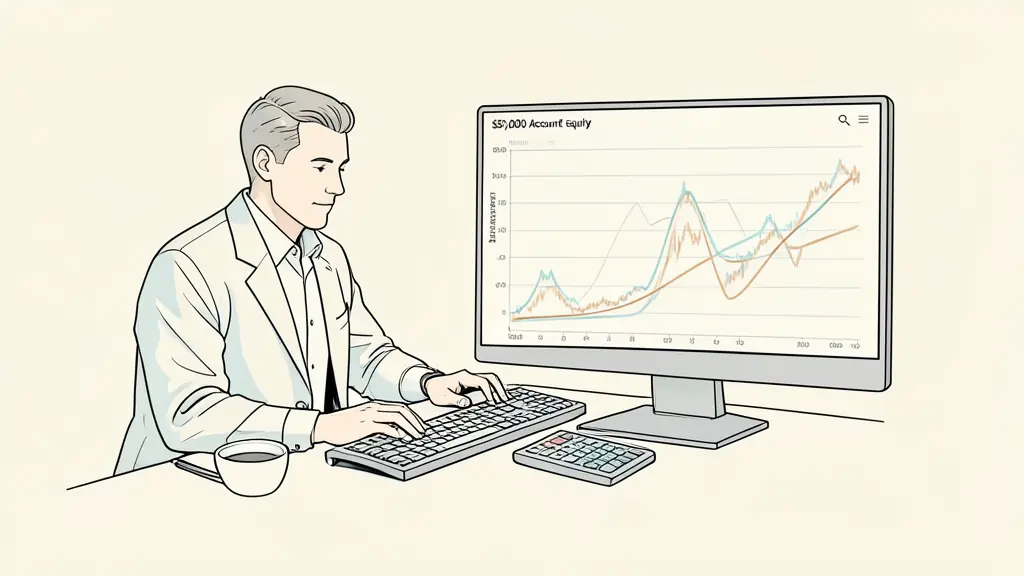
A $50,000 headline balance does not tell you how much risk capacity you have. Assume an illustrative $2,500 loss allowance. A static threshold stays at $47,500. An end-of-day trailing threshold may rise only after profitable daily closes. If the account closes at $51,000, the threshold could move to $48,500, depending on the contract.
With intraday trailing drawdown, an unrealized peak may move the liquidation level immediately. If equity touches $51,000 before returning to $50,000, the threshold could already have advanced to $48,500. The open gain therefore changes the room available for later losses.
This is why the best prop firm for futures cannot be selected by account size alone. During a futures trading challenge, confirm whether trailing uses balance, equity, intraday peaks, or end-of-day values.
When can profits actually be withdrawn?
Verification date: October 8, 2026. No current payout schedule or profit split was supplied.
Compare futures prop firm payouts using the complete withdrawal test:
- First eligible request date
- Minimum trading days
- Consistency requirement
- Per-request withdrawal cap
- Profit split
- Required safety buffer
- Effect of withdrawal on the loss threshold
Suppose a $50,000 account displays $3,000 in profit. Under a hypothetical rule requiring a $2,000 buffer and imposing a $1,000 cap, only $1,000 is initially eligible before applying any profit split. Withdrawing it may also leave less distance above the futures prop firm drawdown threshold. Displayed profit, eligible profit, and cash received are three different figures.
Will the platform and trading restrictions fit your method?
As of October 8, 2026, platform and strategy permissions for the named providers remain unverified here.
A futures funded account has little value if it excludes your platform, contracts, schedule, or order workflow. Check the binding terms rather than a promotional summary:
- Supported platform and data connection
- Standard and micro contracts
- Permitted trading hours and overnight positions
- Market, limit, stop, and bracket orders
- News trading and automation
- Copy trading and account stacking
- Maximum position size and scaling rules
- Prohibited strategies or conduct
These restrictions can also determine eligibility for futures prop firm payouts. If the rules are ambiguous, obtain written clarification before paying.
Is the funded stage simulated or live?
Verification date: October 8, 2026. No provider-specific transition to live brokerage capital has been confirmed.
An evaluation is a test. Passing it may lead to a simulated performance account rather than an immediately live brokerage account. Those stages can differ in execution assumptions, fees, scaling, loss limits, and withdrawal conditions.
Do not infer live funding from words such as “funded” or from the displayed balance. A claim that traders move to live capital should identify the triggering conditions, account structure, and applicable agreement. Without current official documentation, the transition remains unknown.
How can you choose without exceeding your risk limits?
Decision framework dated October 8, 2026. Verify all conditions again immediately before purchase.
Use this checklist before selecting a provider:
- Can your normal stop and position size remain comfortably within the futures prop firm drawdown?
- Does the full monthly cost fit your fixed challenge budget?
- Does your expected trade frequency satisfy activity and consistency rules?
- Are your platform, connection, contracts, and trading hours supported?
- Can you meet payout conditions without increasing risk?
Decision path:
Rules verified? If no, stop.
If yes, calculate usable drawdown.
Risk plan fits? If no, reject the account.
If yes, calculate total cost and realistic payout access.
Save a dated copy of the rules and correspondence. Futures trading can cause substantial losses. Consult a qualified financial professional when appropriate.
This article does not replace advice from a qualified professional: consult a specialist about your own situation.
FAQ
Are futures prop firms regulated like futures brokers?
Not necessarily. Many sell evaluations and provide simulated accounts rather than brokerage accounts. Verify the legal entity, account structure, broker relationship, and any registration claims through official CFTC and NFA resources.
Is a static drawdown better than a trailing drawdown?
A static drawdown is generally easier to plan around because its threshold does not rise with account equity. A trailing drawdown can still work for disciplined traders, but its calculation method and stopping point must be understood precisely.
How much should I risk per trade during an evaluation?
No percentage suits everyone. Set risk from the actual distance to the loss threshold, not the advertised account size, and leave room for commissions, slippage, losing streaks, and daily loss rules.
Can a futures prop firm refuse a payout?
A provider may reject or adjust a request when its published eligibility, consistency, prohibited-strategy, or verification rules are not met. Read the current payout policy and retain copies of the terms that applied when you enrolled.
Should I choose the cheapest futures evaluation?
Not on price alone. A low entry fee can become expensive after resets, activation charges, market-data fees, restrictive drawdown rules, or payout conditions that do not fit your strategy.

Maureen Benoit décrypte le fonctionnement des sociétés de trading financé et compare leurs programmes avec clarté et indépendance. Elle partage des conseils pratiques pour aider les traders à choisir une prop firm adaptée et à mieux gérer leur compte financé.
Envie d'aller plus loin ?
Laisse ton email, on te prévient dès qu'un nouvel article sort.